Network Security Foundations — CIA Triad, Threats, Controls & Packet Flow
Learning Outcomes
By the end, students can:
-
Explain CIA Triad and related security models (AAA, Zero Trust).
-
Identify common threats, actors, and attack techniques across network, endpoint, web, wireless, and human layers.
-
Map controls (preventive/detective/corrective) and design a defense‑in‑depth architecture with segmentation, firewalls, IDS/IPS, VPNs, and logging.
-
Trace a packet from a client to the Internet and back, describing what happens at each OSI layer and at a stateful firewall (policy, NAT, inspection, logging).
-
Use basic tools (ping, traceroute, nslookup/dig, netstat/ss, tcpdump/Wireshark) to observe packet flow and troubleshoot.
1) Core Security Models
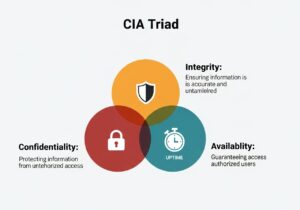
CIA Triad
-
Confidentiality: Prevent unauthorized disclosure of data.
-
Controls: Encryption (at rest/in transit), access control (RBAC/ABAC), data classification & labeling, DLP, VPNs, need‑to‑know.
-
Metrics: # of unauthorized access incidents, % encrypted data, classification coverage.
-
-
Integrity: Ensure data is accurate and unaltered.
-
Controls: Hashing (SHA‑256), digital signatures, file integrity monitoring (FIM), checksums, immutability (WORM), version control, input validation.
-
Metrics: Hash mismatch rate, failed signature verifications.
-
-
Availability: Accessible when needed.
-
Controls: Redundancy (HA clusters, RAID), backups & DR, load‑balancers, DDoS protection, capacity planning, patching, UPS/generators.
-
Metrics: SLA uptime, MTTR/MTBF.
-
Extended Models & Principles
-
AAA: Authentication (prove identity), Authorization (what you can do), Accounting (logs/billing/audit).
-
Zero Trust: “Never trust, always verify”; continuous authZ, micro‑segmentation, strong identity, device posture checks, least privilege.
2) Threat Landscape
Threat Actors
-
External: Cybercriminals (ransomware groups), hacktivists, state‑sponsored, competitors.
-
Internal: Malicious insiders, careless users, contractors, misconfigurations.
Attack Surfaces & Common Attacks
-
Network layer:
-
Recon (port scanning, banner grabbing), sniffing, spoofing (IP/MAC), ARP poisoning, DHCP starvation, VLAN hopping, STP abuse, MITM, DDoS (SYN/UDP/ICMP floods), DNS poisoning/spoofing, BGP hijack (conceptual), fragmentation attacks.
-
-
Endpoint: Malware (virus, worm, Trojan), ransomware, keyloggers, rootkits, supply‑chain.
-
Web/App: SQLi, XSS, CSRF, SSRF, authN/authZ flaws, insecure deserialization, file inclusion (LFI/RFI), directory traversal.
-
Wireless: Evil twin AP, deauth attacks, weak pre‑shared keys, KRACK‑style issues (concept).
-
Human/Social: Phishing (bulk), spear phishing, whaling, vishing, smishing, pretexting, baiting.
Kill Chain / ATT&CK (high‑level)
-
Recon → 2. Resource Development → 3. Initial Access → 4. Execution → 5. Persistence → 6. Privilege Escalation → 7. Defense Evasion → 8. Credential Access → 9. Discovery → 10. Lateral Movement → 11. Collection → 12. Command & Control → 13. Exfiltration/Impact.
3) Security Controls & Architecture
Control Types
-
By purpose: Preventive (MFA, NGFW), Detective (IDS, SIEM alerts), Corrective (patching, restore), Deterrent (warning signs/CCTV), Recovery (backups/DR), Compensating (interim safeguards).
-
By nature: Administrative (policies, training), Technical (crypto, ACLs, EDR), Physical (locks, guards, cages).
Defense in Depth (Layered)
-
Physical (DC security, locks, cameras)
-
Network (segmentation, firewalls, VPN)
-
Endpoint (EDR, hardening)
-
Application (WAF, SAST/DAST, secure SDLC)
-
Data (encryption, DLP, backups)
-
Users (MFA, awareness)
-
Visibility (logs, SIEM, UEBA, SOAR)
Network Security Building Blocks
-
Segmentation & Zoning: VLANs/subnets, DMZ, management network, prod vs. dev/test; micro‑segmentation with NAC/SDN.
-
Firewalls:
-
Packet filters (stateless), stateful inspection, NGFW (app‑ID, user‑ID, IPS, URL filtering), WAF (HTTP/HTTPS layer 7 for web apps).
-
Rule anatomy: Source/destination, service/port, app/user, schedule, action, logging; implicit deny at end; “least privilege”.
-
-
NAT/PAT: Private → public translation, VIP/DNAT for services; preserves addressing and reduces exposure.
-
IDS/IPS: Signature, anomaly, behavior; inline prevention vs. passive detection; tuning to reduce false positives.
-
Proxies: Forward (users to Internet), reverse (Internet to apps in DMZ); caching, TLS termination, inspection.
-
VPNs:
-
IPSec (site‑to‑site, IKEv2, Phase 1 SA → Phase 2 ESP, tunnel mode),
-
SSL/TLS VPN (remote access, client, or portal).
-
-
Identity & Access: MFA, SSO, RBAC/ABAC, Privileged Access Mgmt (PAM), 802.1X + NAC.
-
Cryptography: Symmetric (AES‑GCM), Asymmetric (RSA/ECC), Hash (SHA‑256), HMAC, digital signatures, certificates & PKI, OCSP/CRL.
-
Key Management: Rotation, storage (HSM/TPM), secrets management vaults.
-
Data Protection: Classification, DLP (endpoint/email/gateway), backups (3‑2‑1 rule, offline/immutable), retention.
-
Monitoring & Response: Central logging, SIEM correlation, alert triage, playbooks, basic IR lifecycle (prepare → identify → contain → eradicate → recover → lessons learned).
4) OSI & TCP/IP Refresher (for Packet Flow)
-
OSI: L7 App, L6 Presentation, L5 Session, L4 Transport (TCP/UDP), L3 Network (IP), L2 Data Link (Ethernet), L1 Physical.
-
TCP/IP: Application, Transport, Internet, Network Access.
-
Data units: L2 Frame, L3 Packet, L4 Segment/Datagram.
5) Packet Flow: Client → Internet → Client (Narrative)
A. Getting Online (Bootstrapping)
-
DHCP: Client broadcasts DHCPDISCOVER; server replies DHCPOFFER; client sends DHCPREQUEST; server sends DHCPACK. Lease includes IP, subnet mask, default gateway (router), DNS server.
-
ARP: Client ARP‑resolves the MAC of its default gateway to send traffic off‑subnet.
B. DNS Resolution
-
Client asks resolver (UDP/53 or TCP/53; DoT on port 853/DoH on port 443, if enabled).
-
Resolver may query root → TLD → authoritative servers, caches response.
-
Response returned with TTL.
C. TCP 3‑Way Handshake (to web server)
-
SYN → 2. SYN‑ACK → 3. ACK; session established; window size and MSS negotiated.
-
TLS Handshake (HTTPS): ClientHello (ciphers, SNI, ALPN) → ServerHello (+ certificate) → key exchange (ECDHE) → Finished messages → Encrypted HTTP.
D. Through the Switch & Router/Firewall (Outbound)
-
Switch (L2) forwards frames by MAC table; may apply port‑security, VLAN tagging.
-
Router/Firewall (L3/NGFW) inbound processing (typical order, vendor‑neutral):
-
Interface/Zoning check → sanity (anti‑spoof/RPF) → Session lookup → Route lookup → Security policy → NAT → Security profiles → Log decision → Egress queue/QoS.
-
- NAT/PAT translates private source IP/port to public IP/port; session table records mapping and timers.
E. Across the Internet
-
ISP edge → upstream routers via BGP → destination network. Latency, MTU/MSS, fragmentation avoidance (PMTUD) affect performance.